


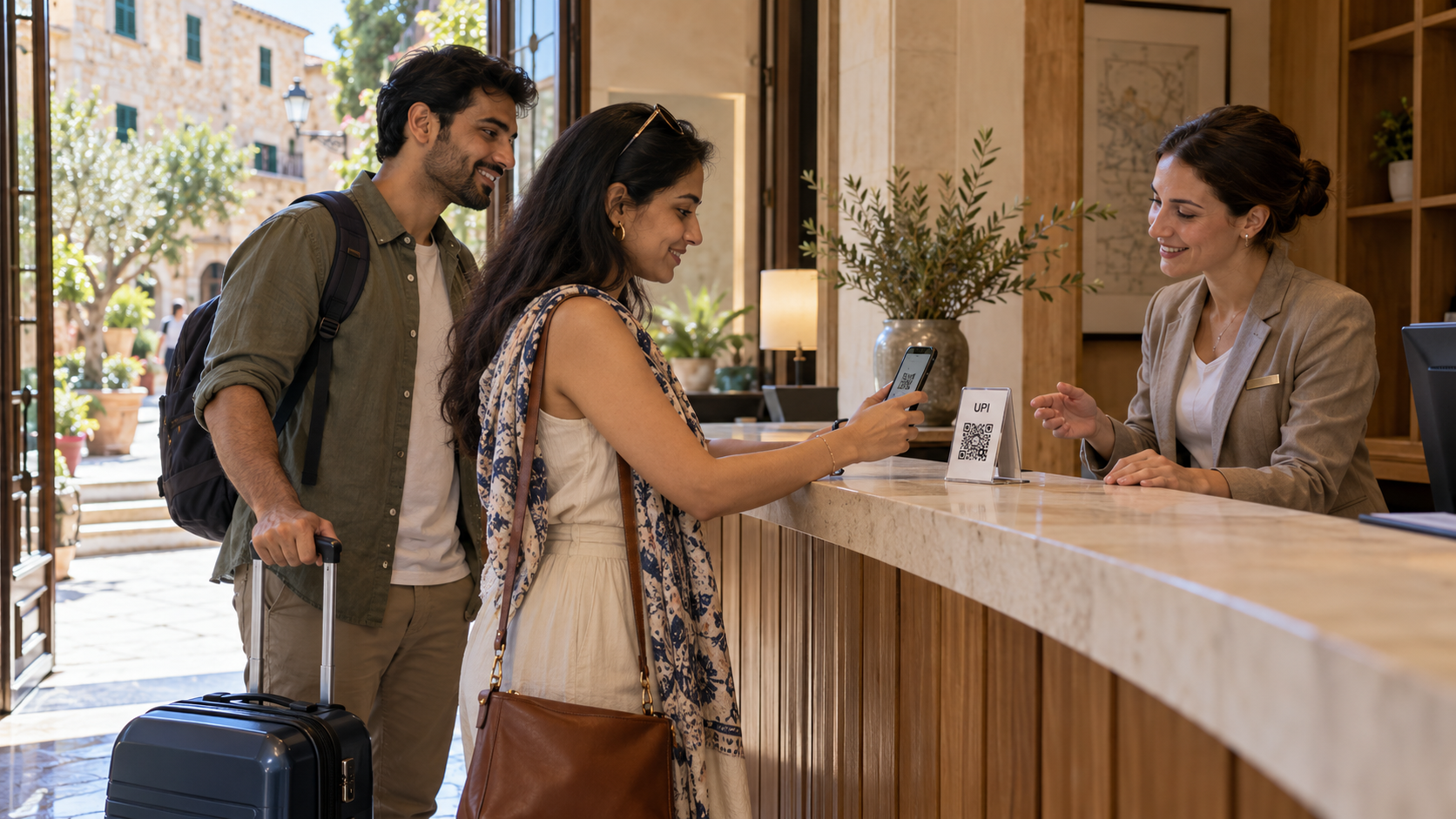
Opening the Global Fintech Fest in Mumbai on 8 September 2026, Prime Minister Narendra Modi announced that India’s Unified Payments Interface (UPI) is now live in 11 countries, and set its next goal: linking UPI with the domestic payment systems of partner countries, starting with those that host large Indian diasporas and strong trade ties. UPI processed a record 24.51 billion transactions worth Rs 29.82 lakh crore (more than $310 billion) in August 2026 alone, and the Department of Financial Services is in talks with seven to eight more countries. Indians spent $16.9 billion on overseas travel in FY 2024-25, making travel the largest single category of outward remittances. For national tourism boards and destination marketing organisations, UPI acceptance is fast becoming as important to winning Indian travellers as visa facilitation and air connectivity. T&A Consulting helps tourism boards and DMOs design India market strategies that integrate digital payment readiness, trade partnerships and targeted promotion to capture a larger share of Indian outbound spending.
Introduction: Ten Years of UPI, and the Move Beyond Borders
UPI completed ten years of operation on 25 August 2026. In that time it has grown from 1.78 crore transactions in FY 2016-17 to more than 24,162 crore transactions in FY 2025-26, an increase of almost 13,000 times. More than 55 crore users had been onboarded by June 2026, and IMF data show that UPI accounted for approximately 49% of global real-time payment transaction volume in 2024. For a generation of Indian consumers, scanning a QR code is now the default way to pay, from street vendors to luxury retailers.
That habit travels. In FY 2023-24, Indians spent a record $31.7 billion abroad under the Liberalised Remittance Scheme, of which travel accounted for 54%, or about $17 billion. Travel spending held steady at $16.9 billion in FY 2024-25, and total LRS outflows were $29 billion in FY 2025-26. The West Asia conflict caused a temporary dip, with monthly travel remittances falling 16% to $1.09 billion in March 2026 as airspace closures disrupted routes, but the structural trend is upward. In 2023, 28.2 million Indians travelled abroad, surpassing pre-pandemic levels.
Previous analysis on this blog examined India’s outbound tourism boom and how foreign companies can use India’s digital public infrastructure to enter the Indian market. This piece looks at the intersection of the two: how the internationalisation of UPI is changing the competitive landscape for destinations seeking Indian visitors, and what tourism boards should do about it.
Where UPI Works Abroad Today
International expansion is led by NPCI International Payments Limited (NIPL), the National Payments Corporation of India’s overseas subsidiary, through partnerships with foreign governments, banks and payment service providers. As of June 2026, UPI services had gone live across 12 international partnerships spanning person-to-merchant and person-to-person payments.
- Gulf and Indian Ocean markets. The UAE introduced merchant payments in April 2022 through Mashreq Bank’s NeoPay, Network International and Magnati. Qatar, Mauritius and the Maldives have since joined, giving Indian travellers familiar payment options across some of their most visited short-haul destinations.
- South Asian neighbours. UPI is live in Bhutan, Nepal and Sri Lanka. Nepal added person-to-person payments through Nepal Clearing House Limited in June 2026, extending UPI from tourist spending into remittances.
- Southeast and East Asia. Singapore’s PayNow is directly linked with UPI, the model the Prime Minister cited for future integrations. Cambodia became the latest addition in June 2026, with merchant payments through ACLEDA Bank, and NIPL has signed a partnership with NTT DATA to enable acceptance in Japan.
- Europe. France was the first European market to accept UPI, and Greece is among the most recent additions, opening the door to wider European acceptance.
- The next wave. Department of Financial Services Secretary M Nagaraju has said India is in talks with seven to eight more countries, prioritising the Middle East and East Asia, where large numbers of Indians live and travel, before expanding further in Europe.
Why Payment Rails Shape Destination Choice
The profile of the Indian outbound traveller makes payment convenience unusually important. According to Niyo’s 2025 travel report, based on data from more than one million Indian travellers, millennials and Gen Z accounted for nine out of ten international trips, two-thirds of trips originated from Delhi, Bengaluru and Mumbai, and 63.8% were taken solo. These are digital-first consumers who manage budgets on their phones and expect payments to work the way they do at home.
- Lower friction and cost. UPI offers travellers an alternative to cash and international card networks, with real-time confirmation and spend tracking in a familiar app. For small merchants in destinations, it opens access to Indian customers without requiring them to accept international cards.
- A marketing signal. UPI acceptance tells Indian travellers that a destination has prepared for them, in the same way Hindi-speaking staff and Indian cuisine do. Destinations that publicise acceptance at attractions, retail and dining can differentiate themselves in a crowded market.
- Competitive dynamics in short-haul markets. Thailand and the UAE accounted for 23.08% and 21.57% of trips in Niyo’s data. The UAE is already a UPI market, while Thailand is not among the markets publicly confirmed as live by NIPL, illustrating how payment acceptance is becoming a variable that competing destinations can actively shape.
- Beyond tourism spending. Person-to-person linkages, such as Singapore and Nepal, extend UPI into remittances and student payments. For destinations that also recruit Indian students or host Indian diaspora communities, UPI integration supports education and family ties as well as leisure travel.
The Inbound Mirror: UPI One World
The same infrastructure is being opened to foreign visitors to India. In February 2026, NPCI extended its UPI One World wallet to delegates from more than 40 countries attending the India AI Impact Summit in New Delhi. The prepaid wallet, offered through authorised issuers such as Transcorp’s CheqUPI app, allows foreign visitors to make merchant payments by scanning UPI QR codes without an Indian bank account or mobile number, with loads of up to Rs 25,000 per transaction and Rs 50,000 a month.
This matters for India’s own inbound tourism, which has lagged. Foreign tourist arrivals recovered to around 9.2 million in 2025, still below the 2019 peak of 10.9 million, and ICRA’s August 2026 analysis identified easier travel processes as one of the levers for recovery. For international MICE organisers, airlines and tour operators bringing visitors to India, UPI One World offers a practical way to give delegates access to India’s cashless economy. For India’s state tourism boards, it is a tool to make the country easier to navigate for first-time visitors.
Implications for Tourism Boards and Destination Marketing Organisations
- Engage NIPL and local acquirers early. National tourism boards in markets without UPI acceptance should work with their central banks, payment operators and acquiring banks to open discussions with NIPL, positioning their country in the next wave of the seven to eight markets under negotiation.
- Drive merchant acceptance where it counts. In markets where UPI is already live, acceptance is often concentrated in a few locations. DMOs should prioritise onboarding at airports, major attractions, shopping districts, hotels and restaurants that Indian visitors frequent most.
- Put payments into the marketing message. Integrate UPI acceptance into India campaigns, travel trade training and influencer content. For digital-first Gen Z and millennial travellers, “scan and pay as at home” is a tangible reason to choose one destination over another.
- Use payment data to sharpen strategy. Partnerships with payment providers can, within privacy rules, generate aggregated insights into Indian visitor spending patterns by city, category and season, helping DMOs target campaigns and measure return on promotion.
- Connect tourism, education and trade. Agencies responsible for international student recruitment and trade promotion should coordinate with tourism counterparts, since UPI linkages support remittances, student payments and business travel as well as holidays.
- For India-bound travel, promote UPI One World. Tourism boards and MICE organisers bringing delegations into India should brief travellers on UPI One World so they can participate fully in India’s cashless economy.
How T&A Consulting Supports Destinations Courting Indian Travellers
T&A Consulting represents national tourism boards and destinations in India and brings strong thought leadership on digital public infrastructure:
- India market strategy for tourism boards. We develop data-driven India strategies that combine traveller segmentation, source-city prioritisation, air connectivity and payment readiness into a single go-to-market plan.
- Payment readiness assessments. We assess a destination’s UPI and Indian payment acceptance landscape, identify gaps at key touchpoints and map the stakeholders needed to close them.
- Stakeholder facilitation. We help destinations engage Indian payment ecosystem players, outbound tour operators, airlines and online travel agencies to build partnerships that make travel easier for Indian visitors.
- India representation and trade engagement. We provide in-market representation, travel trade training and roadshows that communicate a destination’s readiness for Indian travellers.
- Cross-sector corridor programmes. We link tourism with student recruitment and trade promotion so that destinations benefit from the full range of India-related flows that UPI integration supports.
For a generation of Indian travellers who pay for everything with a scan, the destinations that accept UPI will feel like home and the ones that do not will feel like work. As India pushes to link UPI with payment systems worldwide, payment readiness is becoming a frontier of destination competitiveness.
Contact us at: pnijhawan@taglobalgroup.com to make your destination payment-ready and grow your share of Indian outbound travel.
Sources & references:
PMIndia: PM’s address at Global Fintech Fest 2026,
Inc42: PM Modi urges fintechs to step up cybersecurity, consumer protection,
Free Press Journal: UPI expands to 12 international partnerships,
NPCI: UPI One World extended to India AI Impact Summit delegates,
Skift: Travel is India’s biggest global spending category,
Kotak Neo: Overseas travel spending by Indians falls 16% in March 2026