


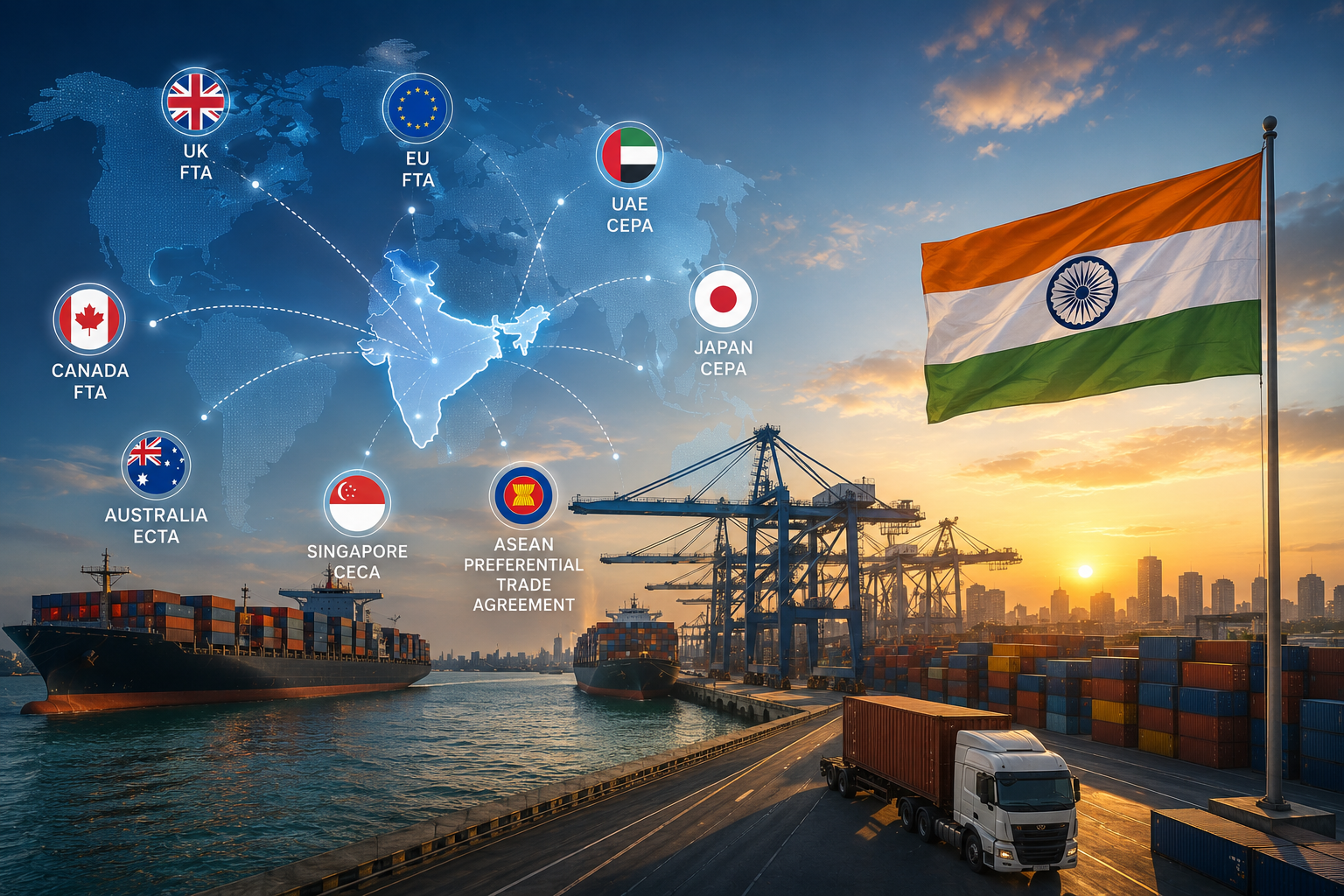
In the span of twelve months, India has concluded or operationalised trade agreements with the European Union, the United Kingdom, the European Free Trade Association and the United States, while maintaining existing agreements with ASEAN, Japan, South Korea and several other partners. This expanding web of preferential trade arrangements is transforming India’s position in global value chains and creating new multi-market strategies for companies that understand the architecture. T&A Consulting helps businesses, investment promotion agencies and governments navigate India’s trade agreement landscape and identify cross-agreement opportunities.
Introduction: A Structural Shift in India’s Trade Strategy
For decades, India was cautious about free trade agreements. Concerns about domestic industry protection, agricultural sensitivities and the perceived imbalance of existing agreements (particularly with ASEAN) made policymakers reluctant to pursue ambitious trade liberalisation. That approach has fundamentally changed. Between October 2025 and February 2026, India operationalised or concluded four major trade agreements with some of the world’s wealthiest economies, creating a preferential trade network that covers a significant share of global GDP.
The strategic logic is clear. India is positioning itself as a manufacturing and services hub with preferential access to multiple major markets simultaneously. A company operating from India can now potentially access preferential terms in the EU (25% of global GDP), the UK, EFTA nations, ASEAN, Japan, South Korea, the UAE and other partner countries. This multi-jurisdictional access, combined with India’s domestic market of 1.45 billion consumers, competitive manufacturing costs, large talent pool and expanding digital infrastructure, creates a compelling proposition for global companies seeking a “China plus one” or multi-hub operating model.
The Agreement Landscape: A Summary
- India-EU FTA (concluded January 2026, entry into force expected early 2027). The world’s largest free trade zone: 2 billion people, 25% of global GDP. Eliminates tariffs on 96.6% of EU goods exports. Car tariffs cut from 110% to 10% over 5 years. Services liberalisation across financial services, IT, professional services. €4 billion annual savings for EU exporters. CBAM provisions with €590 million transition support.
- India-UK CETA (signed July 2025). Duty-free access on 99% of India’s exports. Market access across 137 UK service sub-sectors. Double Contribution Convention for social security. Professional mobility provisions. Education services coverage supporting university campus expansion.
- India-EFTA TEPA (in force from October 2025). $100 billion FDI commitment over 15 years from Switzerland, Norway, Iceland and Liechtenstein. Immediate investment from Roche (1.5 billion CHF). Pharmaceutical, financial services and precision engineering focus.
- US-India Interim Trade Framework (February 2026). Effective tariff reduced from 50% to 18% (further reduced to 10% post-SCOTUS). Zero tariffs on gems, pharma, smartphones, handicrafts. Ongoing comprehensive BTA negotiations. Energy and geopolitical commitments.
- Existing agreements. ASEAN-India FTA (in force since 2010, covering goods and services with 10 ASEAN nations). India-Japan CEPA (2011). India-South Korea CEPA (2010). India-UAE CEPA (2022, with over $84 billion bilateral trade). India-Australia ECTA (2023). India-Mauritius CECPA (2021). India-New Zealand agreement ($20 billion FDI commitment, implementation from 2026).
Cross-Agreement Strategy: How Companies Should Think
The real strategic value is not in any single agreement but in the network effect. A foreign company can now structure operations to leverage multiple agreements simultaneously. Consider the following scenarios:
- European manufacturer. Establish manufacturing in India under PLI schemes. Export to the EU under the India-EU FTA (near-zero tariffs on most goods). Export to the UK under the India-UK CETA (99% duty-free). Export to ASEAN under the India-ASEAN FTA. Serve the Indian domestic market directly. One manufacturing base, four market corridors.
- Swiss pharmaceutical company. Leverage the India-EFTA TEPA for investment facilitation. Set up R&D and manufacturing under the pharma PLI scheme. Export generics to the EU under zero-tariff provisions. Export to the US under zero reciprocal tariffs for pharmaceuticals. Access India’s healthcare market directly.
- UK professional services firm. Leverage the India-UK CETA’s 137 service sub-sectors for market entry. Use the mobility provisions (Double Contribution Convention) to deploy professionals. Establish a GCC in India for service delivery. Serve EU clients through India-EU FTA services provisions. Global delivery from India to multiple markets.
- Japanese auto component company. Leverage the India-Japan CEPA for existing bilateral trade. Expand manufacturing under the automotive PLI scheme. Export to the EU under the India-EU FTA (tariff elimination on auto components). Supply UK OEMs under the India-UK CETA. Multi-market export platform from India.
What This Means for Investment Promotion Agencies
- Reframe India’s value proposition. India is no longer just a large domestic market or a low-cost production base. It is a multi-market access hub with preferential trade terms across the world’s largest economies. IPAs should lead with this positioning.
- Develop sector-specific, cross-agreement playbooks. For each priority sector (automotive, pharmaceuticals, textiles, IT services, food processing), map the tariff benefits, market access provisions and mobility arrangements across all relevant agreements.
- Target companies already in India for expansion. Companies with existing India operations may not be aware of the new cross-agreement opportunities. IPAs should proactively advise existing investors on how to leverage new agreements.
- Coordinate across bilateral relationships. India’s trade agreements interact and sometimes overlap. IPAs should develop expertise in the full agreement architecture, not just bilateral relationships.
Risks and Considerations
India’s expanding trade agreement network also creates complexities. Rules of origin vary across agreements, meaning companies must carefully manage sourcing and production to qualify for preferential tariffs. The India-EU FTA’s CBAM provisions impose carbon costs that other agreements do not. Some agreements (US-India) remain interim and could change. The domestic political dynamics around agricultural market opening, dairy imports and automotive competition will continue to influence implementation.
Companies and advisors should also track the investment protection landscape carefully. India has terminated over 70 bilateral investment treaties since 2015 and has avoided ISDS mechanisms in recent agreements (EFTA, and likely EU). The absence of traditional investment arbitration protections is a material consideration for companies making large, long-term capital commitments.
How T&A Consulting Supports Trade Strategy
T&A Consulting provides comprehensive trade agreement advisory across India’s entire FTA network:
- Multi-agreement opportunity mapping. We identify and quantify cross-agreement opportunities for specific companies, sectors and supply chains.
- Rules of origin advisory. We help companies structure sourcing and production to qualify for preferential tariffs across multiple agreements.
- Market entry strategy. We design India entry strategies that leverage the full trade agreement architecture for multi-market access.
- IPA and EDA advisory. We help investment promotion organisations develop trade agreement-integrated investment attraction strategies.
- Ongoing monitoring. We track ratification timelines, implementation developments and negotiation progress across all agreements, providing timely updates to our clients.
India’s trade agreement architecture has reached a critical mass. The country now has preferential access to markets representing more than half of global GDP. For companies and investment promotion agencies, the question is no longer whether India offers trade advantages, but how to optimise operations across a network of agreements that creates multi-market value from a single India base.
Contact us at: pnijhawan@taglobalgroup.com to explore how India’s trade agreement network creates opportunities for your organisation.
Sources & references:
European Commission,
Ministry of Commerce, Government of India,
India Briefing,
PIB,
World Economic Forum